How to Market Your Staffing Agency Online in 2026: The Complete Guide
Here’s a uncomfortable truth: most staffing agencies have no marketing strategy.
They rely on referrals, word-of-mouth, and maybe a Indeed job posting or two. Which works — until it doesn’t. Until a competitor starts ranking above you on Google. Until the referrals slow down. Until you realize that your biggest client knows three other agencies and just picked the one they found first online.
The good news: marketing a staffing agency isn’t complicated. You don’t need a $50K budget or a marketing team. You need a Google Business Profile, a handful of blog posts, and about 2 hours a week.
This guide is for agency owners and operators who want to stop leaving business on the table.
Why Most Staffing Agencies Ignore Marketing
Let’s be honest about the objections:
“We get all our business from referrals.” Great — but referrals don’t compound. Content marketing does. A blog post you write today can drive leads for 5 years.
“Marketing is expensive.” The most effective channels for staffing agencies (Google Business Profile, SEO, email) cost almost nothing. You’re spending money on job boards anyway.
“Our clients don’t find us online.” Actually, 68% of B2B buyers research vendors online before making contact (Gartner). Your next client Googled “staffing agency [your city]” last week. Were you there?
“We’re too small for marketing.” You’re the exact right size. Big agencies have 12-month sales cycles and enterprise RFPs. You can close a local client in one meeting — if they can find you.
The Staffing Agency Marketing Stack (Ranked by ROI)
Here’s what actually works, in order of impact:
1. Google Business Profile (Free, Highest ROI)
This is the single most impactful thing you can do. When someone searches “staffing agency near me” or “industrial staffing [city],” Google shows the Map Pack — and 46% of all Google searches have local intent.
Set it up right:
- Business name: Your actual business name (don’t keyword-stuff)
- Category: Primary = “Staffing Agency” or “Temporary Staffing Agency”; add secondary categories like “Employment Agency,” “Recruiting Firm”
- Description: 750 characters. Include your specialties, industries served, and geographic area. Natural keywords, not spam.
- Services: List every service (temporary staffing, direct hire, temp-to-perm, payroll, etc.)
- Photos: Office photos, team photos, job site photos (with permission). Businesses with 100+ photos get 520% more calls than average.
- Hours: Keep accurate. Nothing kills credibility like wrong hours.
Get reviews — this is the game:
- Ask every placed candidate and satisfied client for a Google review
- Make it easy: send them a direct link (search “Google review link generator”)
- Respond to EVERY review (positive and negative)
- Target: 50+ reviews puts you ahead of 90% of local staffing agencies
- Agencies with 4.5+ stars and 50+ reviews dominate the Map Pack
Post regularly:
- Google Business Profile has a “Posts” feature — use it weekly
- Share job highlights, hiring events, industry news
- Posts show up in your listing and signal to Google that you’re active
2. Your Website (Foundation for Everything)
You don’t need a $20K custom site. You need:
Must-haves:
- Clear value proposition above the fold: who you serve, what you do, why you’re different
- Service pages for each staffing type (temporary, direct hire, specialized)
- Industry pages for each vertical you serve (industrial, manufacturing, construction, etc.)
- Location pages if you serve multiple cities (this is huge for local SEO)
- Contact form and phone number on every page
- Mobile-friendly design (60%+ of traffic is mobile)
- Fast loading (under 3 seconds)
Nice-to-haves:
- Client testimonials/case studies
- Blog (more on this below)
- Job listings (even a simple page with current openings)
- Team bios (people hire people)
Tech recommendations:
- WordPress with a clean theme ($0-$200)
- Squarespace ($16-$49/month, easier to manage)
- Or Hugo/Astro for static sites (free hosting, fastest possible)
- Don’t spend more than $2,000 on a website. Seriously.
3. SEO: Content That Brings Clients to You
SEO (search engine optimization) is the long game — and it’s the most valuable marketing channel for staffing agencies because the intent is so high. Someone searching “industrial staffing agency Houston” is ready to buy.
Two types of SEO for staffing agencies:
A. Local SEO (for client acquisition) Target searches like:
- “[industry] staffing agency [city]”
- “temp agency near me”
- “construction staffing [region]”
How to rank:
- Google Business Profile (see above)
- Location-specific pages on your site
- Local directory listings (Yelp, Thumbtack, industry directories)
- Reviews, reviews, reviews
B. Content SEO (for candidate acquisition and brand authority) This is what we do at TradespeopleHQ — create content that candidates search for, which builds your brand and fills your candidate pipeline simultaneously.
Target searches like:
- “How to become a [trade]”
- “[Trade] salary guide”
- “[Certification] requirements”
- “Best [trade] apprenticeship programs”
Why this works for agencies:
- Candidates who find your content sign up for your database
- Google sees you as an authority in your industry
- Clients who find your content see that you deeply understand their workforce
- Content compounds — a post written today drives traffic forever
Blog post ideas for staffing agencies:
- Salary guides for your industries (“Welder Salary Guide for [Region]”)
- Certification explainers (“OSHA 30 vs OSHA 10: Which Do You Need?”)
- Career path guides (“How to Get Into [Industry] With No Experience”)
- Industry trends (“The [Industry] Labor Shortage: What Employers Need to Know”)
- Hiring tips for clients (“How to Reduce No-Shows on Day One”)
Publish 2-4 posts per month. Each one should target a specific keyword with actual search volume.
4. Email Marketing (Cheap, Effective, Underused)
Most staffing agencies send zero marketing emails. This is a massive missed opportunity.
For clients:
- Monthly newsletter with market insights, salary benchmarks, and hiring tips
- Quarterly “talent availability” updates for your region
- Case study emails showing placement success stories
- Use Mailchimp (free up to 500 contacts) or Brevo
For candidates:
- Job alert emails by trade/region
- Career development content (your blog posts!)
- Certification and training opportunities
- SMS is better for candidates (see our SMS vs Email guide), but email works for white-collar and professional segments
Metrics to track:
- Open rate: staffing industry average is 25-30%
- Click rate: 3-5% is solid
- Unsubscribe rate: keep under 1%
5. LinkedIn (B2B, Free to Start)
LinkedIn is where your clients are — staffing decision-makers (HR directors, ops managers, procurement).
What to post:
- Industry insights and labor market commentary
- Placement success stories (anonymized if needed)
- Your blog content (repurposed for LinkedIn format)
- Engage with client companies’ content
What works on LinkedIn for staffing:
- Personal posts from the agency owner (not the company page)
- Data and insights (“We’ve seen a 40% increase in welder demand in the Gulf Coast this quarter”)
- Opinions on industry trends
- Behind-the-scenes of your operation
Cadence: 3-5 posts per week. Comment on 10+ posts per day. This alone can generate 2-3 qualified leads per month.
6. Paid Advertising (When You’re Ready)
Start here ONLY after your organic foundation is solid.
Google Ads (highest intent):
- Target: “[industry] staffing agency [city]”
- Budget: $500-$2,000/month for local
- Expected cost per lead: $25-$75
- Works best with a clear landing page and phone tracking
Facebook/Instagram Ads (candidate acquisition):
- Target: workers by job title, interest, and location
- Budget: $300-$1,000/month
- Great for “we’re hiring” campaigns
- Use video — short, authentic clips perform best
Indeed Sponsored Jobs (candidate pipeline):
- You’re probably already here
- Optimize listings with better titles and descriptions
- Track cost-per-application, not just clicks
The 2-Hour Weekly Marketing Plan
Here’s what a realistic, sustainable marketing routine looks like:
| Day | Task | Time |
|---|---|---|
| Monday | Write and schedule 1 Google Business Profile post | 15 min |
| Monday | Post on LinkedIn (industry insight or job market update) | 15 min |
| Wednesday | Write 1 short blog post OR work on a longer one | 45 min |
| Wednesday | Post on LinkedIn (client success or placement story) | 15 min |
| Friday | Respond to all Google reviews from the week | 10 min |
| Friday | LinkedIn engagement (comment on 15-20 posts) | 20 min |
Total: ~2 hours/week. That’s it.
After 6 months of consistency:
- 24+ Google Business Profile posts
- 12+ blog posts ranking in Google
- 100+ LinkedIn posts building your network
- Measurably more inbound leads
Measuring What Matters
Don’t track vanity metrics. Track these:
| Metric | Tool | Goal |
|---|---|---|
| Google Business Profile views | GBP Dashboard | Growing month over month |
| Website visits from organic search | Google Analytics (free) | 500+/month within 6 months |
| Inbound leads/month | Your CRM or spreadsheet | 3-5 qualified leads/month |
| Cost per lead | Track by channel | Under $50 for local |
| Google review count and rating | GBP Dashboard | 50+ reviews, 4.5+ stars |
Common Mistakes
Trying to do everything at once. Start with Google Business Profile and your website. Add channels one at a time.
Quitting after 30 days. SEO takes 3-6 months. Most agencies give up right before it starts working.
Writing content for yourself, not your audience. Your blog should answer questions your candidates and clients actually ask — not just promote your services.
Ignoring reviews. Reviews are the #1 factor in local search ranking. A 3.8-star rating versus a 4.7-star rating is the difference between getting the call and being invisible.
Not tracking leads. If you can’t tell where your leads come from, you can’t optimize. Use a simple spreadsheet at minimum.
How TalentPrism Fits In
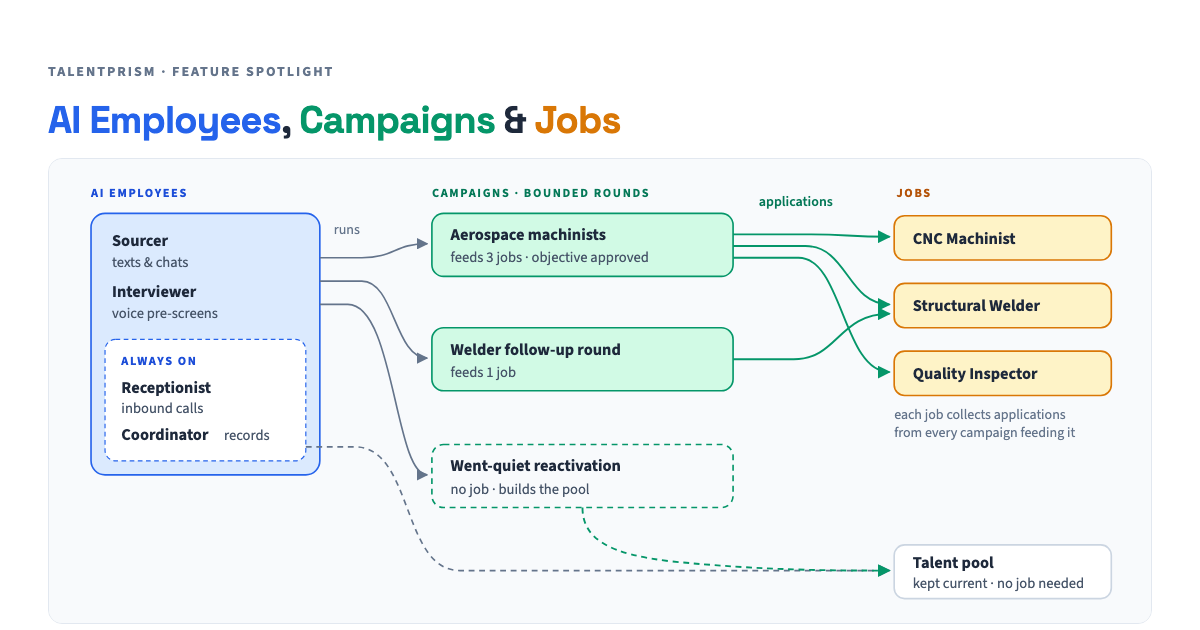
If you’re an industrial staffing agency, your candidate marketing doesn’t have to be complicated. TalentPrism automates the candidate engagement piece:
- SMS campaigns that reach your existing database
- AI-powered screening that qualifies candidates before you spend time on them
- Automated follow-up sequences that keep candidates warm
- Analytics that show you which campaigns and channels perform
You handle client relationships. We handle candidate reactivation and engagement. Your marketing drives inbound candidates → TalentPrism turns them into placements.
Want to see how it works? Visit TalentPrism.com or text DEMO to [NUMBER].
Related: Why SMS Beats Email for Blue-Collar Recruiting | A2P 10DLC Compliance Guide | Staffing Agency Retention Playbook