Most recruiters have had the same frustrating moment with a search tool: a candidate ranks third — or doesn’t show up at all — and there is no way to tell why. The score is a black box. The filters might be doing too much, or too little. So the recruiter widens the net, scrolls further, and trusts their gut.
TalentPrism’s matching engine is built around the opposite idea: every ranking decision should be explainable in plain English, and every candidate should appear for a reason the recruiter can see.
Here is what happens, end to end, when a recruiter types one sentence.
The five stages, in under two seconds
AI Search Planner
Reads intent and routes each phrase to the right field
Three filter layers
Separates ranking signal from must-haves and context
Matching engine
Ranks every candidate, dimension by dimension
Post-search annotations
Adds context without filtering anyone out
Ranked + explained
Match Report with a dimension breakdown
Hard filters · pass / fail
Stage 04 detailAI match explanation
Stage 05 detailWhy 54%, in plain English
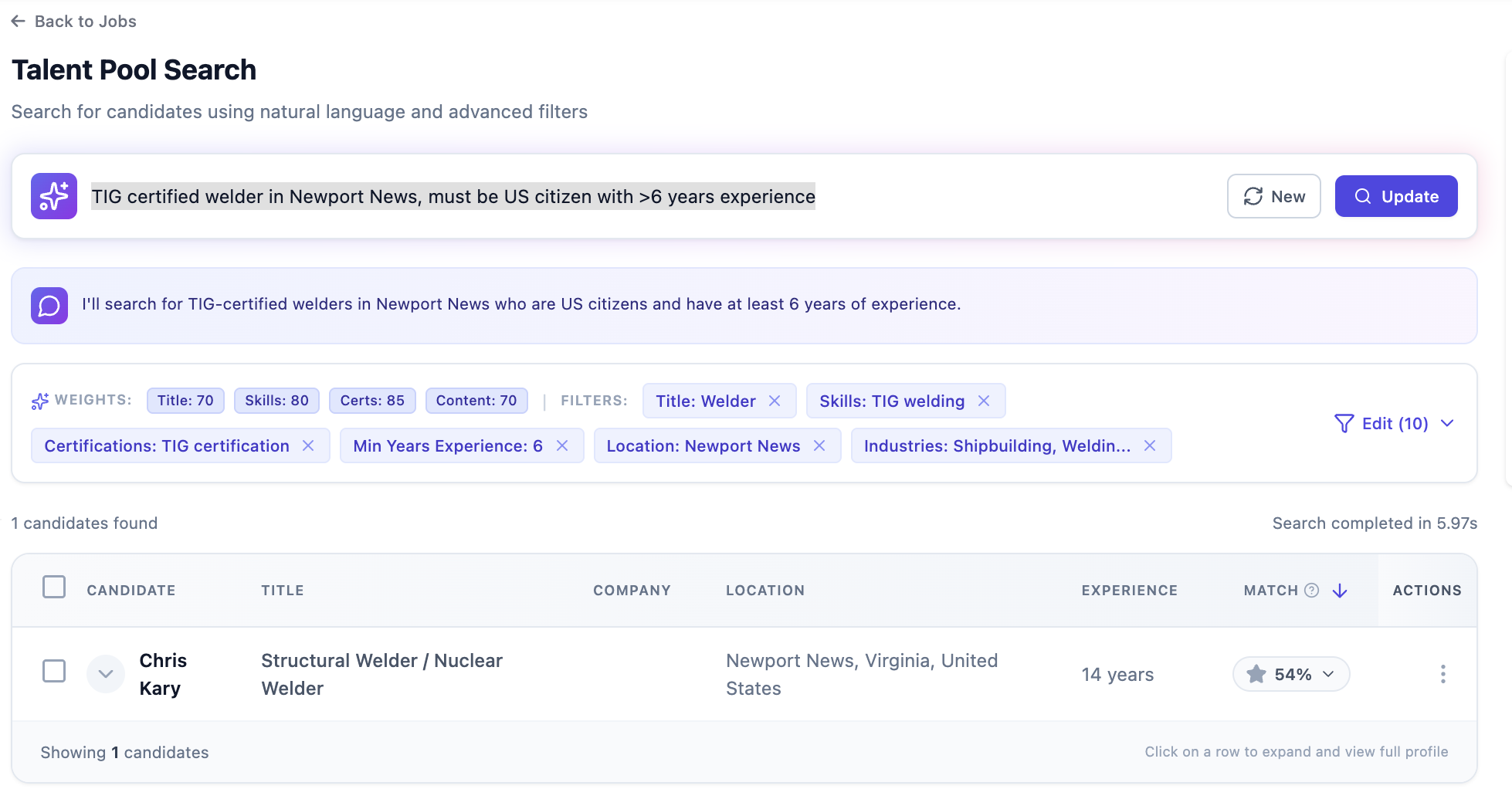
Chris passes every hard filter — Newport News location and 14 years of structural / nuclear welding well above the 6-year floor.
Score lands mid-range because heavily weighted phrases — "TIG certification" and "US citizen" — aren't verbatim in the indexed profile text. The signal exists in the resume; it just isn't echoed in the searchable fields.
Bottom line: promising, worth a review. The recruiter can confirm fit in one expand instead of dismissing on score alone.
The recruiter writes one sentence. The planner builds the structured search. The engine ranks. The system annotates. The Match Report puts it all back into plain English. That's the whole loop.
The diagram above is the whole story in one picture. The rest of this post walks through each of the five stages in plain language, then shows what they look like on a real shipyard hiring search.
01 · Plan — the AI reads the recruiter’s intent
The first thing the engine does is read the sentence the way a colleague would. It picks out the role (welder), the skill (TIG welding), the certification (TIG-certified), the location (Newport News), the citizenship requirement, and the experience floor (6 years) — and routes each phrase to the right field in the underlying search.
There is no special syntax. No filter setup. A recruiter who has never used the product can describe the ideal candidate the way they would describe them to a teammate, and the planner builds the structured search for them.
02 · Decompose — three filter layers, each with a job
This is the part that makes results easy to trust. Every query is split into three layers, and each layer has a different job:
- Semantic filters (ranking) — phrases that should influence how high a candidate ranks: “TIG welding,” “structural welder,” “TIG certification.” These are signals, not gates.
- Exact filters (exclusion) — strict requirements. Newport News. Minimum 6 years. If a candidate fails one of these, they are out.
- Soft preferences (annotation) — things like available now or salary expectation. These add context next to a candidate but never hide them when the data is missing.
The reason this matters: a strong candidate whose profile is missing a soft field never gets quietly dropped. Hard requirements protect the must-haves. Semantics drive the ranking. Soft preferences add color.
03 · Match — ranking by every dimension that matters
The engine compares every candidate in your database against the query across multiple dimensions — title, skills, certifications, and the full text of the resume. It looks for meaning, not just exact keywords. That is the difference that lets the engine recognize that:
- TIG and GTAW mean the same welding process
- HII and Huntington Ingalls Industries are the same employer
- Flux-core and FCAW describe the same skill
- Stick welding and SMAW are interchangeable on a resume
Each dimension carries a weight the planner inferred from the recruiter’s wording. A query that leads with “TIG-certified” weights certifications higher. A query that leads with “10+ years” weights experience higher. The recruiter never has to set these weights manually — but every one of them is visible and editable if they want to.
04 · Enrich — adding context, never hiding anyone
Once the ranking is done, the engine layers on annotations: distance from the search origin, availability tags, last time the candidate was contacted, industry overlap. None of these reorder the list or filter anyone out — they just add useful context next to each name.
05 · Explain — every score, in plain English
This is the step that closes the loop on the “black box” problem. Every result row shows an overall match percentage and a dimension-by-dimension breakdown — Title 18%, Skills 17%, Certifications 15%, Resume Content 3%. One click expands the row into a full Match Report, with an AI-generated explanation that names what matched and what is missing — in language an account manager or agency owner can read without a glossary.
The recruiter never has to guess why a candidate ranked where they did. Neither does anyone reviewing the shortlist with them.
What this looks like on a real search
Theory is fine. Here is what the engine does on an actual shipyard hiring surge.
The query, typed in plain English:
Find TIG or flux-core shipyard welders within 75 miles of Pascagoula with 6+ years experience, SMAW FCAW GTAW, AWS or NAVSEA certification, and previous Ingalls or HII work.
That is a sentence with a lot going on: two welding processes named two different ways, three certifications, a 75-mile radius, an experience floor, and a specific employer history. A classic Boolean search would need every one of those terms spelled exactly right to find anything. A recruiter would spend ten minutes building it.
What came back: a full top-20, every result in the Pascagoula area.
- #1 — 74% match — Pipe Welder, 9 years, shipbuilding and industrial fabrication, GTAW/TIG, SMAW, flux-core, AWS D1.1 certified.
- #2 — 74% match — First Class Welder, nearly 30 years, shipbuilding and industrial construction, FCAW/SMAW/GTAW, AWS and NCCER credentials.
- #3 — 67% match — 1st Class Shipfitter, 14 years, GMAW/FCAW/SMAW, structural fabrication.
- #4 — 66% match — Welder, 6 years, flux/stick/MIG certified, shipbuilding background.
- #6 — 65% match — First Class Welder, nearly a decade at Huntington Ingalls Industries.
Where this beats keyword search. We ran the same top 20 through a strict keyword check, requiring every must-have term — TIG, FCAW, SMAW, AWS, NAVSEA, Ingalls, HII, shipyard — to appear verbatim. The result: zero profiles matched all eight.
But the matching engine still surfaced strong candidates, because it understood that TIG is GTAW, that flux-core is FCAW, that HII is Huntington Ingalls. The recruiter wrote the request the way they would speak it. The engine matched the way the resumes were actually written.
Why this matters for staffing leaders
Three things change when ranking is built this way:
- Faster time to shortlist. Recruiters describe the role in one sentence instead of building filter chains. The first set of viable candidates appears in seconds.
- Transparent ranking. Every score breaks down into dimensions, and every dimension is explainable in plain English. Account managers and agency owners can review a shortlist and immediately understand the why behind each name — no engineer required.
- No hidden candidates. Soft preferences add context — they do not remove anyone. A strong candidate whose profile is incomplete still shows up, ranked honestly, with the gaps surfaced rather than hidden.
The full loop — recruiter sentence in, ranked-and-explained shortlist out — runs in under two seconds. The recruiter’s mental model does not change. The work that used to take fifteen minutes of filter-tuning takes one sentence.
That is the bet behind the matching engine: that a tool good enough to trust is more valuable than a tool that is merely fast.