There’s a moment every staffing firm hits during a hiring surge: you know the candidates are in your database. Thousands of them. But your recruiters are already maxed out, and nobody has time to call 6,000 people to find out who’s still interested.
That’s exactly where a national aerospace staffing firm found itself in February 2026.
The Problem
A major aerospace manufacturer needed aircraft assemblers. Not a handful — enough to staff three separate production lines: systems, electrical, and structures assembly.
The staffing firm had the database. 6,089 candidates who’d worked aerospace assembly roles before. Many hadn’t been contacted in months. Some had moved, changed numbers, or left the industry entirely.
The traditional playbook? Assign recruiters to start dialing. At 15 minutes per conversation, including voicemails, callbacks, and no-answers, that’s 1,500+ hours of recruiter time just for initial outreach. And that’s before a single application gets collected.
They didn’t have 1,500 hours. They had open job orders and a deadline.
The Approach
Instead of hiring more recruiters or burning out the ones they had, the firm deployed TalentPrism across all three campaigns simultaneously.
The setup was straightforward:
- Upload the candidate lists for each role (Aircraft Systems Assembler, Aircraft Electrical Assembler, Aircraft Structures Assembler)
- TalentPrism sends personalized SMS and email outreach to each candidate
- Candidates who respond get an automated conversation, not a rigid chatbot script, but a real back-and-forth about what they’re looking for
- Interested candidates can search open jobs, submit applications, sign up for alerts, or get routed to a recruiter
- TalentPrism handles the entire intake conversation, only flagging candidates that need human attention
No new recruiter hires. No overtime. No phone banks.
The Results (Feb 14 – Mar 30, 2026)
Here’s what happened across all three campaigns:
Reach and Engagement
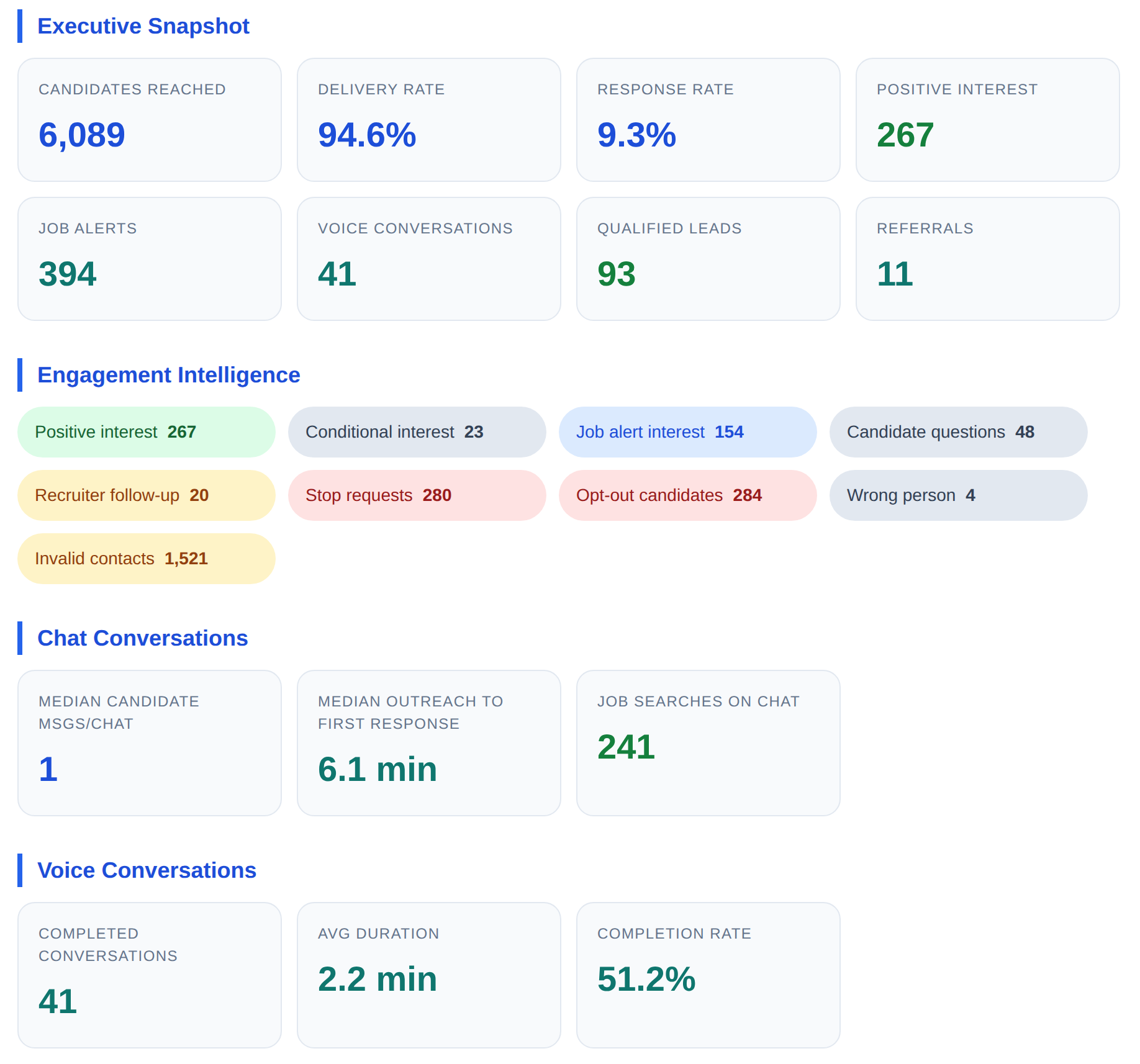
This wasn’t just a top-of-funnel blast. TalentPrism reached thousands of dormant candidates, restarted conversations at scale, and surfaced qualified demand without forcing recruiters to manually work through the entire database first.
Downstream Attribution That Actually Matters
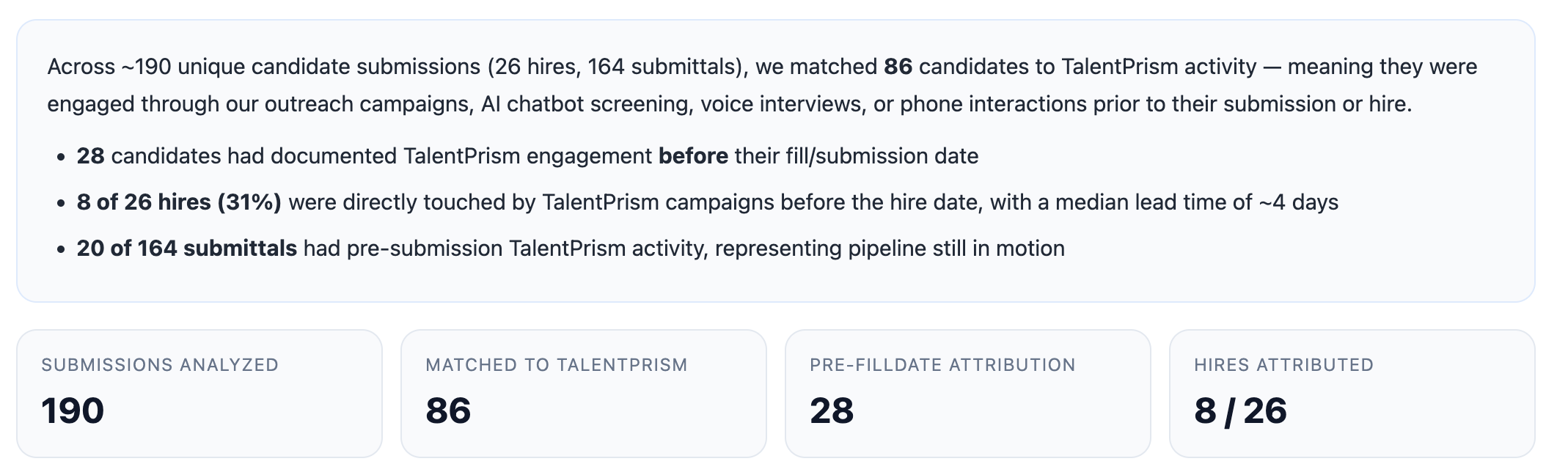
Top-of-funnel numbers are useful. But staffing operators care about submitted candidates and hires.
In this campaign, there were 190 total downstream candidate outcomes:
- 26 hired
- 164 submitted
And TalentPrism activity showed up before those downstream outcomes often enough to matter:
- 28 of 190 total outcomes (15%) had TalentPrism activity before fill date
- 8 of 26 hires (31%) had TalentPrism activity before fill date
- 20 of 164 submitted candidates (12%) had TalentPrism activity before submission date
In one aerospace campaign, TalentPrism activity appeared before fill date in 8 of 26 hires.
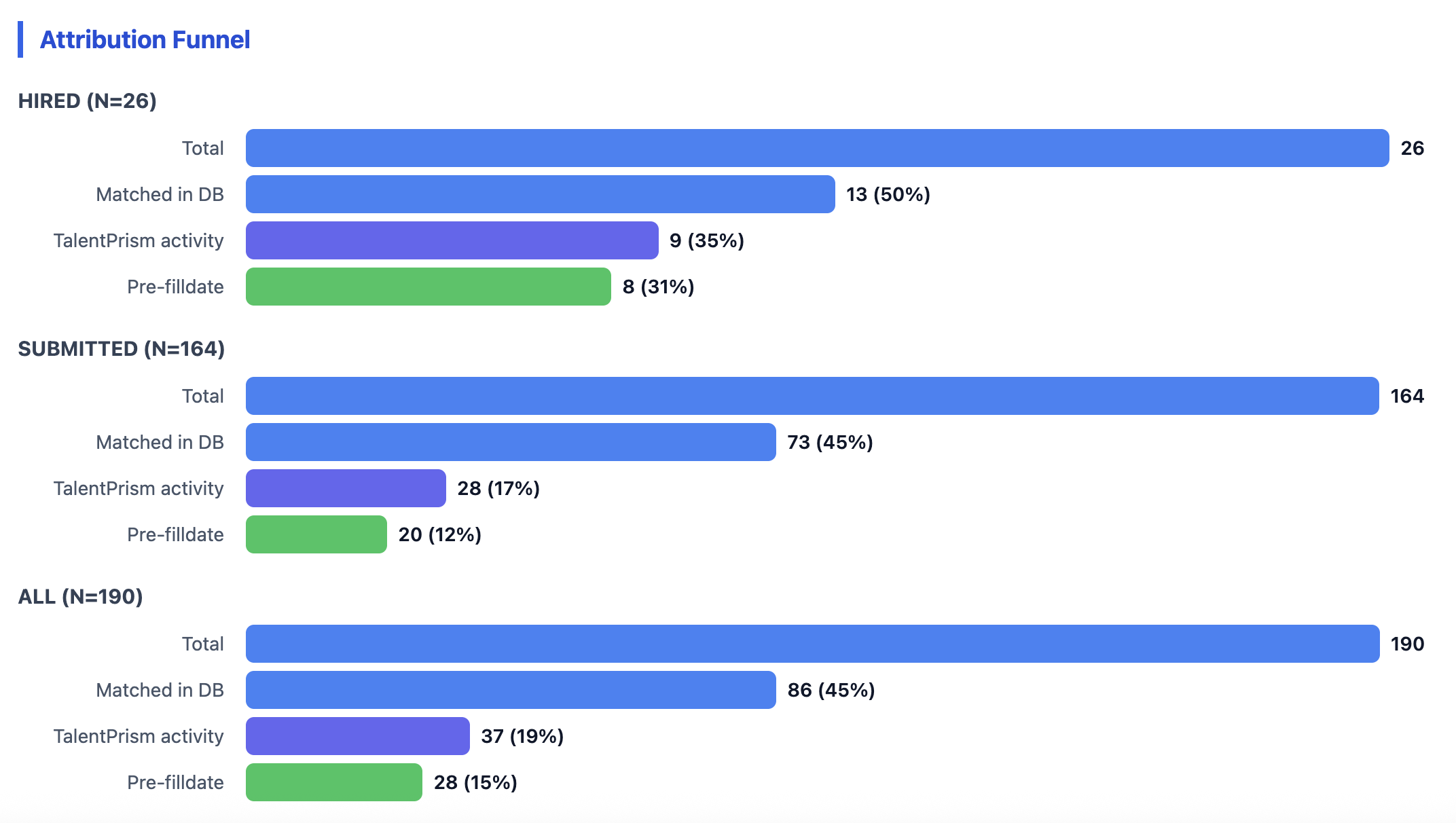
That matters because it moves the story beyond engagement metrics. This wasn’t just more texting. TalentPrism activity showed up upstream of real recruiter outcomes.
What That Activity Looked Like
Across those 190 downstream outcomes, TalentPrism activity appeared across multiple channels. These counts are non-mutually-exclusive, which means some candidates had activity in more than one channel:
| Channel | Count |
|---|---|
| Outreach | 31 |
| Chat | 15 |
| Interview | 19 |
| Phone call | 16 |
This is the more honest way to talk about attribution in staffing. Candidates don’t always follow a neat single-touch path. They move through conversations, outreach, follow-up, and recruiter handoff.
Candidate Journeys
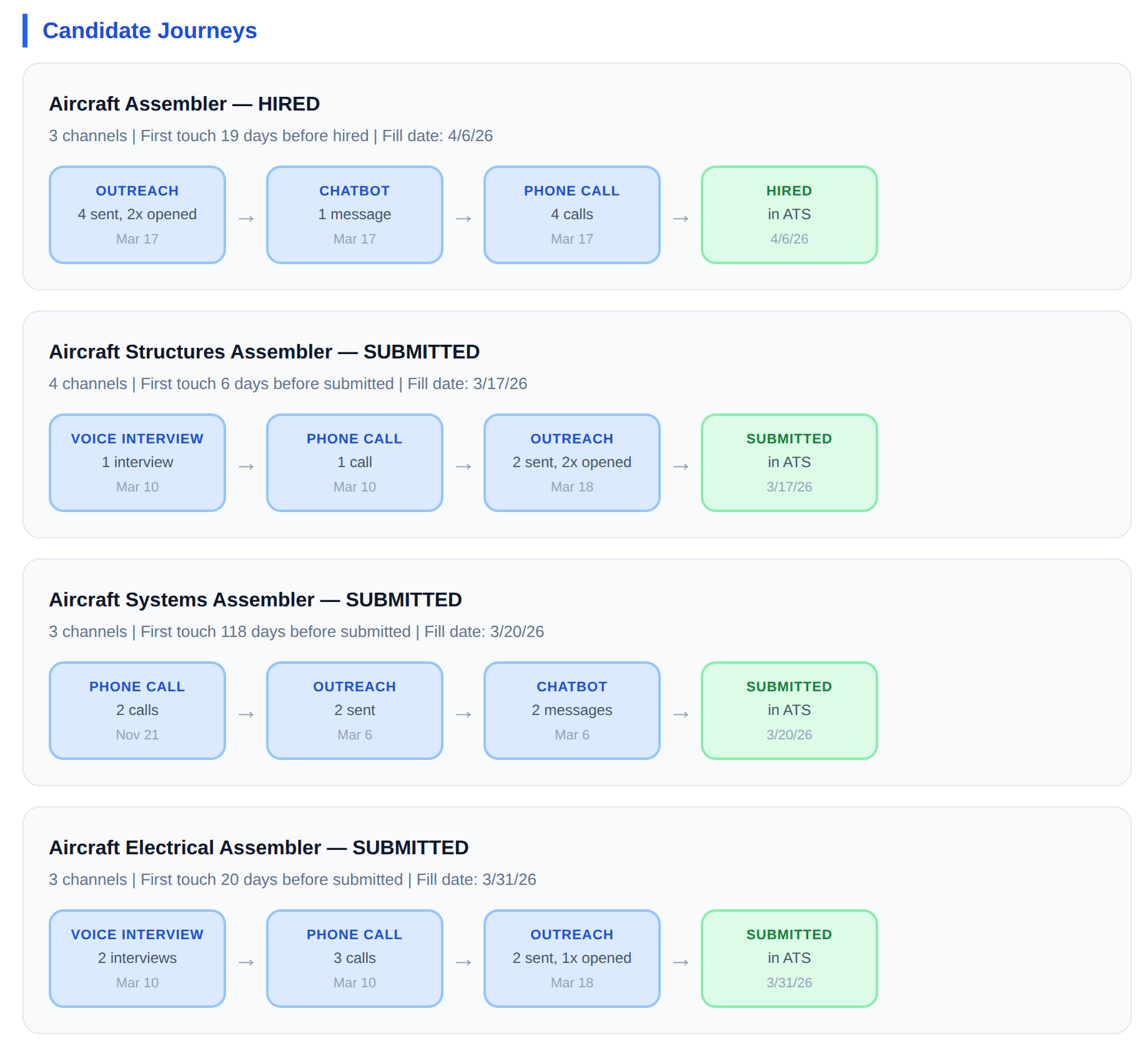
The numbers tell one story. The individual paths tell another. Here are a few anonymized examples of how candidates moved through TalentPrism before reaching a downstream outcome:
Aircraft assembler, hired — First TalentPrism touch 19 days before hire. Received outreach, chatted with the AI assistant, and had 4 phone calls over two weeks. Submitted and hired on the same req.
Aircraft structures assembler, submitted — First touch 6 days before submission. Completed a voice conversation and a phone call on day one, then received follow-up outreach. Submitted to the client within a week.
Aircraft systems assembler, submitted — First touch 118 days before submission. An early phone call in November didn’t convert, but a follow-up outreach in March re-engaged them. Chatbot interaction and a second outreach sealed the reactivation. Submitted two weeks later.
Aircraft electrical assembler, submitted — First touch 20 days before submission. Two voice conversations and three phone calls created deep engagement. Follow-up outreach kept momentum. Submitted by end of month.
The pattern is consistent: TalentPrism created the first touchpoint, maintained contact across channels, and kept candidates warm until the recruiter was ready to submit. In some cases, a single outreach months later reactivated a candidate who’d gone quiet after an earlier conversation.
Why the Campaign Worked
The campaign worked because TalentPrism created momentum before recruiters had to step in:
- 267 positive-interest candidates raised their hand
- 394 job alert subscribers created a reusable warm audience for future openings
- 41 voice conversations gave candidates another path to engage
- 93 qualified leads gave recruiters a tighter list to work from
That’s not replacing recruiters. That’s helping them start with signal instead of a cold list of 6,089 names.
The Channel Mix Still Says the Same Thing
The campaign used both SMS and email, but the operating lesson is simple: fast, conversational outreach beats passive database sitting.
For dormant candidate reactivation, the win wasn’t just sending more messages. It was giving candidates an immediate way to reply, ask questions, raise their hand, and move forward without waiting for recruiter bandwidth.
For staffing firms still running slow, manual reactivation plays, this is the takeaway: conversation-first outreach creates more usable signal than a static blast-and-wait approach.
The Surprise: 25% of the Database Was Dead Weight
Here’s something most firms don’t measure — but should.
TalentPrism identified 1,520 invalid contacts across the three campaigns. That’s 24.9% of the entire database.
Bad phone numbers. Dead email addresses. Candidates who’d moved on entirely. One in four records was taking up space and skewing every metric the firm tracked.
Before this campaign, those 1,520 records looked the same as the other 4,571 in the ATS. After? The firm has a clean, validated database — and every future campaign starts with better data.
Database hygiene isn’t glamorous, but it’s the difference between a 3% response rate and a 9% one. You can’t engage candidates who don’t exist anymore.
The Compounding Effect
Here’s what the firm has after this campaign that they didn’t have before:
- 190 downstream outcomes the team can actually map to submitted and hired candidates
- 394 job alert subscribers who’ll get notified automatically on the next opening
- A clean database — 1,520 dead records identified and flagged
- 267 warm candidates with documented preferences, availability, and interest levels
- 93 qualified leads recruiters could act on faster
None of this existed six weeks earlier. The candidates were sitting in a database, untouched. The data was stale. The pipeline was empty.
One automated campaign turned a dormant database into an active talent pool. And because those 394 alert subscribers stay engaged automatically, the next campaign starts warmer than this one did.
That’s the flywheel. Every campaign builds on the last. Every conversation compounds.
The Math for Staffing Operators
Let’s put this in operational terms:
- Without TalentPrism: 6,089 candidates × 15 min avg call attempt = ~1,500 recruiter hours. At $30/hr loaded cost, that’s $45,000 in recruiter time just for outreach before the team even knows who’s still reachable.
- With TalentPrism: 267 positive-interest candidates, 93 qualified leads, 394 alert subscribers, and measurable activity tied to downstream submitted and hired outcomes.
The recruiters didn’t disappear. They showed up to work with real signal: interested candidates documented, qualified leads surfaced, and evidence that TalentPrism activity appeared before some of the campaign’s submitted and hired outcomes.
What This Means for Your Database
If you’re a staffing firm with thousands of candidates you haven’t contacted in months, you don’t have a dead database. You have an untapped talent pool.
The candidates are there. Some will engage immediately. Some will need a follow-up. Some have already fallen out of the market and need to be cleaned out of your working data.
Your recruiters’ time is too valuable to spend on initial outreach at scale. Let TalentPrism restart conversations, collect applications, handle calls, and surface real signal. Then let your recruiters focus where human judgment matters most.
Important caveat: these attribution figures reflect observed TalentPrism activity before fill or submission date, not strict first-touch attribution.
Want to see what a campaign like this looks like on your candidate database? Let’s talk.